
|
Features
|
|
|
|
Books
|
|
|
|
Fun & Games
|
|
|
|
Contact Us
|
|
|
John's Journal... Entry 246, Day 1
THE GREAT MISSOURI GOBBLERS
I Love Missouri Toms
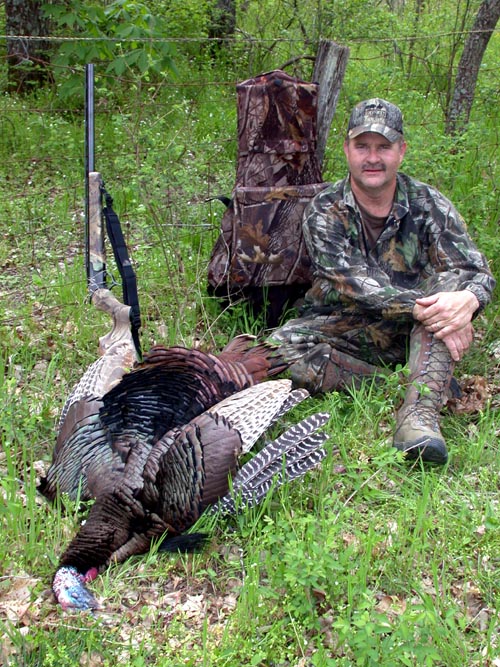 Editor's
Note: I've hunted wild turkeys in more than 30 states, and one of my favorite
places in the world to hunt longbeards is in Missouri. This week I'll
tell you why I love Missouri, and how Missouri humbled me. I assure you,
if you'll come back each day this week, you'll want to be buying your
own ticket to go hunt with Brad Harris, the Product-Development Manager
for Field Line Calls in Missouri.
Editor's
Note: I've hunted wild turkeys in more than 30 states, and one of my favorite
places in the world to hunt longbeards is in Missouri. This week I'll
tell you why I love Missouri, and how Missouri humbled me. I assure you,
if you'll come back each day this week, you'll want to be buying your
own ticket to go hunt with Brad Harris, the Product-Development Manager
for Field Line Calls in Missouri.
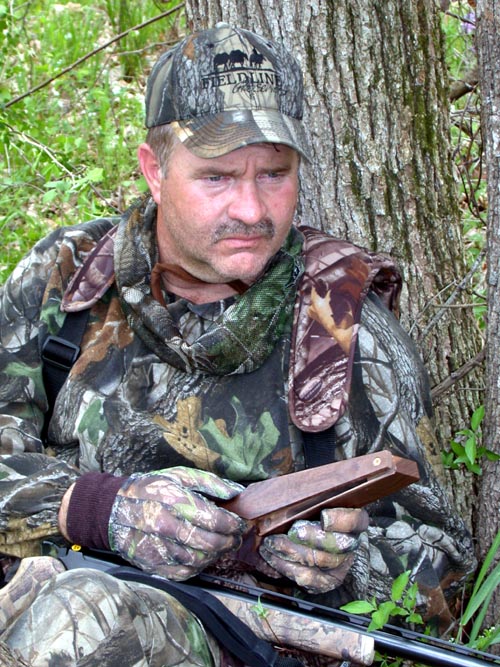
Brad Harris is one of my favorite people to hunt with, and the first time I ever went to Missouri to hunt with Harris, I had several stories on assignment to write. One of the stories was titled, "Pre-Season Scouting for Turkeys." I had planned to go out a day early and scout with Harris to try to find gobblers to hunt, just as I would in my home state of Alabama. So, on the first morning of the hunt, just before first light, Harris and I went to the property we were to hunt and stood at the gate at the entrance of the property. "We should hear some birds gobbling from here," Harris said.
 I
thought, "If we hear one to three turkeys, I'll have a great story, because
then we can determine where the turkeys are located, and what is the best
route to take to get to them the next morning. We can listen to them fly
down, and then use crow calls, owl calls and hawk calls to keep up with
them during the day and learn where the birds go. Then we can hunt them
the next day. Just before first light I heard the first turkey gobble.
Then to my surprise, turkeys began to gobble from every hilltop within
earshot. The sounds of the turkeys gobbling were like the sound of ocean
waves crashing against the shore, one right after the other in a never-ending
stream of continuous gobbles. I never had heard so many turkeys gobble
at the same time in all my life. As soon as I could no longer hear turkeys
gobbling in the distance, a turkey close-by would start the chorus again.
I
thought, "If we hear one to three turkeys, I'll have a great story, because
then we can determine where the turkeys are located, and what is the best
route to take to get to them the next morning. We can listen to them fly
down, and then use crow calls, owl calls and hawk calls to keep up with
them during the day and learn where the birds go. Then we can hunt them
the next day. Just before first light I heard the first turkey gobble.
Then to my surprise, turkeys began to gobble from every hilltop within
earshot. The sounds of the turkeys gobbling were like the sound of ocean
waves crashing against the shore, one right after the other in a never-ending
stream of continuous gobbles. I never had heard so many turkeys gobble
at the same time in all my life. As soon as I could no longer hear turkeys
gobbling in the distance, a turkey close-by would start the chorus again.
 Like
spectators at a football game stand up and raise their hands in the air
creating "the wave," continuous sounds of turkeys gobbling went on and
on and on. My jaw dropped. My eyes got wide, and I looked at Harris and
said, "There must be 1,000 turkeys on this property, and all of them are
gobblers. The only place I've heard any more gobbling is when I was in
Texas listening between two roost trees as hundreds of Rio Grande Gobblers
talked to each other back and forth." Harris laughed, and we kept listening
to turkeys until there was enough light to see. Then Harris said, "Are
you ready to go scouting?" I laughed and said, "Scouting for what? There
are so many turkeys on this land I think we will trip over them."
Like
spectators at a football game stand up and raise their hands in the air
creating "the wave," continuous sounds of turkeys gobbling went on and
on and on. My jaw dropped. My eyes got wide, and I looked at Harris and
said, "There must be 1,000 turkeys on this property, and all of them are
gobblers. The only place I've heard any more gobbling is when I was in
Texas listening between two roost trees as hundreds of Rio Grande Gobblers
talked to each other back and forth." Harris laughed, and we kept listening
to turkeys until there was enough light to see. Then Harris said, "Are
you ready to go scouting?" I laughed and said, "Scouting for what? There
are so many turkeys on this land I think we will trip over them."
Harris laughed, and we walked the property, not scouting
for a turkey, but scouting for groups of gobblers that we would hunt the
following morning. Three of the reasons I like to hunt the Missouri turkeys
are these toms:
 *
gobble a lot and gobble almost all day long, unlike the Alabama turkeys
I'm accustomed to hunting, which gobble very little and often will stay
hush-mouthed when they come off the roost.
*
gobble a lot and gobble almost all day long, unlike the Alabama turkeys
I'm accustomed to hunting, which gobble very little and often will stay
hush-mouthed when they come off the roost.
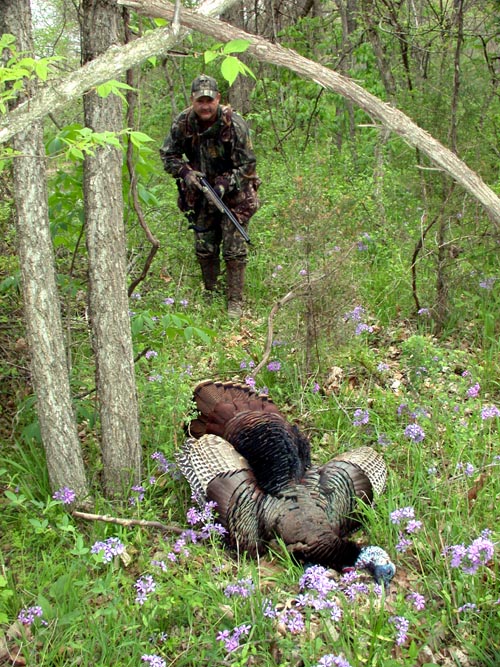
* seem to be much bigger than most Eastern turkeys. No one even raises
an eyebrow when you take a 22-pound gobbler in Missouri. A 24-pound bird
will get some respect, but bigger birds are often taken.
* will come to a call. In many of the places I hunt, the turkeys get so
beat-up by hunters every season that getting them to come in to a call
is almost impossible. I've hunted plenty of states in the East where a
turkey will stand and gobble if he is 60 yards out of range. If the hen
doesn't come to him, he won't go to her. After 15 or 20 minutes of waiting
for her, he will walk away in the opposite direction of the hunter. Missouri
gobblers just make hunters feel good about themselves because you don't
have to really be highly skilled to take one. But, you can't make dumb
mistakes and still go home with a gobbler in the back of your vest.
TOMORROW: THE DAY I LEARNED HUMILITY
Check back each day this week for more about THE GREAT MISSOURI GOBBLERS ...
Day 1 - I Love Missouri
Toms
Day 2 - The Day I Learned Humility
Day 3 - Things Get Worse
Day 4 - The Redemption Gobbler
Day 5 - The Saga Continues